Optical spectroscopy of Moiré homo and heterostructures
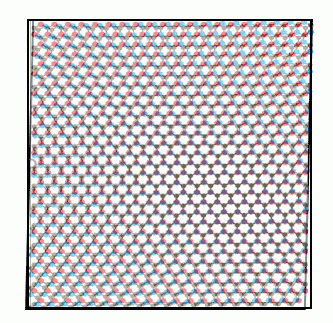
Vertical homo and heterostructures are thought to be van der Waals bound (weak binding), but recent studies suggest that layers may be coupled more strongly, and may also go beyond the rigid lattice picture. Further, the twist angle between layers imparts a tunable moiré period, scaling as (unit cell length)/(twist angle), leading to a modified potential landscape. These moiré heterostructures emerge as an ideal platform to realise new properties and functionalities that are not present in the individual layers. Additionally, the moiré potentials give rise to well defined localized moiré excitons (interlayer and intralayer excitons), that are protected against disorder, and can be tuned with external fields revealing interesting topological phases, many-body interactions, and quantum phase transitions. Optical techniques are ideal to explore these systems due to their strong interaction with light. Using both steady-state and time-resolved optical spectroscopies such as steady-state and time-resolved photoluminescence (TRPL) and transient absorption (Pump-Probe) spectroscopy, we study inter-layer coupling, spin-valley information and fundamental carrier dynamics, which occur over timescales of femtoseconds-nanoseconds.
In reconstructed MoSe₂/WSe₂ heterostructures, atomic reconstruction creates mesoscopic domains with uniform atomic registry that dramatically alter the local potential landscape. Using time-resolved photoluminescence, we reveal that quantum confinement persists in these flat reconstructed regions, uncovering multiple finely-spaced interlayer exciton states (~1 meV separation) with enormous lifetime variations spanning sub-nanosecond to over 100 nanoseconds across a 10 meV energy window. At high excitation rates, we observe a novel effect we term “quantum siphoning” — a transient suppression of emission followed by gradual recovery — demonstrating that nonlinear excitonic dynamics persist well beyond the ideal moiré paradigm.
In WSe₂/WS₂ moiré heterostructures, by optically suppressing ultrafast charge transfer to interlayer excitons, we uncover long-lived moiré intralayer excitons (lifetimes >1000 ps) arising from their localized Wannier and in-plane charge-transfer character. We observe moiré intralayer intervalley biexcitons with a binding energy of ~16 meV — stabilised by moiré confinement — and find time-domain signatures of strong coupling between these excitons and ultralow-energy phasons (~10 μeV), evidenced as twist-angle-dependent GHz oscillations in the exciton dynamics.
Useful references:
Mondal et al., Quantum siphoning of finely spaced interlayer excitons in reconstructed MoSe₂/WSe₂ heterostructures, Nano Letters 26, 5162 (2026)
Dalal et al., Signatures of moiré intralayer biexcitons and exciton-phason coupling in WSe₂/WS₂, arXiv:2601.03045 (2026)
Mondal et al., Quantification of 2D Interfaces: Quality of heterostructures, and what is inside a nanobubble, ACS Applied Materials and Interfaces 16 42608 (2024)
Debnath et al., “Tuning exciton complexes in twisted bilayer WSe2 at intermediate misorientation”, Physical Review B 106 125409 (2022)
Tran et al., “Moiré and beyond in transition metal dichalcogenide twisted bilayers”, 2DMater. 8 022002 (2021)
Tran et al., “Evidence for moiré excitons in van der Waals heterostructures”, Nature 567, 71-75 (2019)