
Integer and Fractional Quantum Hall Effect
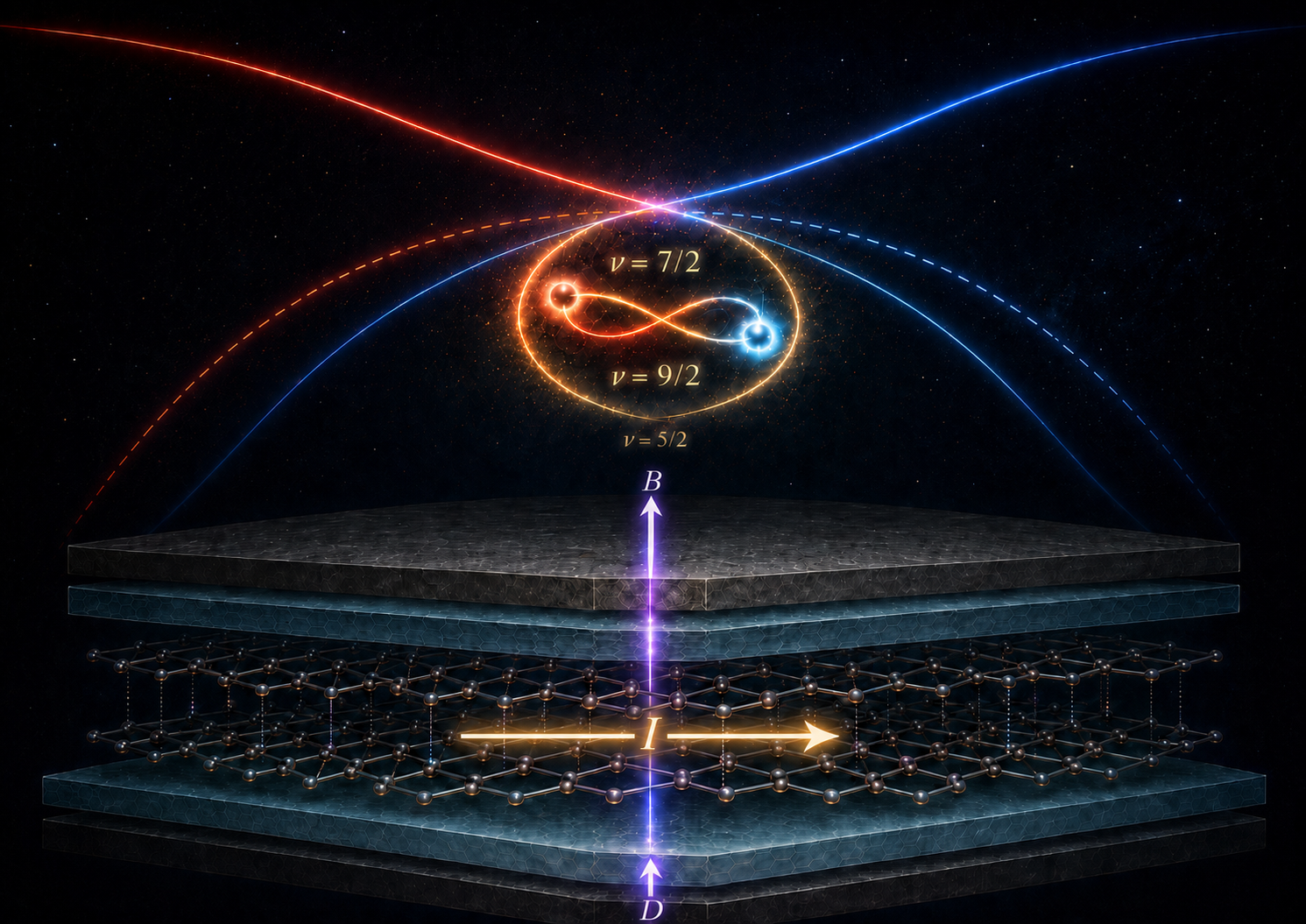
We study correlated electron phases in the quantum Hall regime using ultra-high mobility graphene and trilayer graphene devices. A central theme is understanding how interactions, topology, and disorder together determine the rich phase diagram of these systems — from integer plateaux to exotic fractional states with anyonic quasiparticles.
Some representative results are mentioned below:
Screening-controlled dynamical criticality in the quantum Hall regime – arxiv-2607.09244
Determining how Coulomb interactions influence universal critical behavior of continuous quantum phase transitions is a fundamental open problem in condensed matter physics. We introduce a screening-controlled platform in which the interaction range can be continuously tuned experimentally using the dimensionless ratio of magnetic length to gate distance, enabling systematic control of Coulomb interactions without altering disorder. This enables independent determination of the dynamical and localization-length exponents across quantum Hall plateau transitions. We demonstrate that Coulomb interactions selectively modify the dynamical exponent while leaving the localization-length exponent unchanged, establishing a general experimental strategy for disentangling interaction and disorder effects in quantum critical systems.
Tanima Chanda, Simrandeep Kaur, Anantbir Virk, Kenji Watanabe, Takashi Taniguchi, G. J. Sreejith, Yuval Gefen, Aveek Bid – arxiv.org/abs/2607.09244
Even-denominator fractional quantum Hall states in ABA trilayer graphene – Phys. Rev. Letts. (2026)
Even-denominator fractional quantum Hall states — the most celebrated being the ν = 5/2 state — are candidates for non-Abelian anyons with potential for topological quantum computation. We report the observation of even-denominator FQH states in the zeroth Landau level of the monolayer-like band of ABA trilayer graphene. The multi-band structure of trilayer graphene provides a new tunable platform to explore these exotic states and their competition with other correlated phases.
T. Chanda, S. Kaur, H. Singh, K. Watanabe, T. Taniguchi, M. Jain, U. Khanna, A. C. Balram, Aveek Bid — Phys. Rev. Letts. 137, 036601(2026)
Controlling particle-hole symmetry of fractional quantum Hall states in trilayer graphene – Phys. Rev. Lett. (2025)
Particle-hole symmetry is a fundamental constraint on fractional quantum Hall states at half-filled Landau levels. By tuning Landau level mixing in ABA trilayer graphene using top and bottom gates, we demonstrate the ability to continuously control the particle-hole character of composite-fermion FQH states. Our results directly reveal how competing Coulomb interactions and Landau level mixing sculpt the quantum Hall phase diagram in a multi-layer graphene system, and provide a new experimental handle absent in conventional GaAs heterostructures.
S. Kaur, H. Singh, K. Watanabe, T. Taniguchi, U. Ghorai, M. Jain, R. Sensarma, Aveek Bid — Phys. Rev. Lett. 135, 206501 (2025) | arXiv:2411.18910
Universality of quantum phase transitions in the integer and fractional quantum Hall regimes – Nature Communications (2024)
Fractional quantum Hall phases emerge from strong electronic interactions and are characterised by anyonic quasiparticles, while integer quantum Hall effects arise from the band topology of non-interacting electrons. Despite this fundamental difference, we report a super-universality of the critical behaviour across all FQH and IQH plateau-to-plateau transitions. Contrary to anticipated state-dependent critical exponents, our measurements reveal the same critical scaling exponent κ = 0.41 ± 0.02 and localisation length exponent γ = 2.4 ± 0.2 for fractional and integer quantum Hall transitions. We show that this universal behaviour is recovered in the limit of short-range disorder correlations, which we achieve using a metallic screening layer in ultra-high mobility trilayer graphene devices.
S. Kaur, T. Chanda, K. R. Amin, K. Watanabe, T. Taniguchi, U. Ghorai, Y. Gefen, G. J. Sreejith, Aveek Bid — Nat. Commun. 15, 8535 (2024) | arXiv:2312.06194
Multifractal conductance fluctuations in high-mobility graphene in the integer quantum Hall regime Phys. Rev. Lett. (2022)
The plateau-to-plateau transitions in the integer quantum Hall effect are quantum phase transitions described by a universal critical theory. A direct signature of the underlying critical wave functions is their multifractal spatial structure. We measured conductance fluctuations near quantum Hall plateau transitions in ultraclean graphene and demonstrated that they exhibit multifractal statistics. Our results provide the first direct experimental evidence for multifractality of the critical wave functions at the quantum Hall metal-insulator transition.
K. R. Amin, R. Nagarajan, R. Pandit, Aveek Bid — Phys. Rev. Lett. 129, 186802 (2022) | arXiv:2112.14018